|
Given the ever-increasing variety and volume of chemicals used in society today, together with frequent international trade, harmonising the classification and labelling of chemicals worldwide is a leading international priority. In 1992 the United Nations Conference on Environment and Development (UNCED) and the International Forum on Chemical Safety (IFCS) adopted a resolution recommending that countries undertake international harmonisation of chemical classification and labelling, to reduce the risks chemicals pose to human health and the environment and to lower the cost of complying with differing national labelling requirements in cross-border trade. To this end, the International Labour Organization (ILO), the Organisation for Economic Co-operation and Development (OECD) and the UN Committee of Experts on the Transport of Dangerous Goods (UNCETDG) jointly developed the Globally Harmonized System of Classification and Labelling of Chemicals (GHS). After many years of harmonisation, the GHS documentation completed by these three organisations was adopted and officially promulgated by the United Nations in 2003.
The GHS defines 27 hazard classes (seeTable 1). Each class sets out detailed classification criteria, the elements to appear on hazard-communication labels, and the classification process. While class names such as flammable gases and flammable liquids match the nine major categories of hazardous substances used domestically, and the classification test standards are similar, the scope of the definitions differs. For example, the GHS criterion for flammable gas is "a gas having a flammable range in air at 20°C and standard pressure", whereas the Hazard Communication Rules define flammable gas as "a gas that is combustible at 15°C and one atmosphere" — a considerably broader scope.
Table 1 GHS Classification of Chemical Hazards
|
Physical Hazards
|
Health and Environmental Hazards
|
|
Explosives
|
Acute Toxicity |
| Flammable Gases |
Skin Corrosion/Irritation |
| Flammable Aerosols |
Serious Eye Damage/Eye Irritation |
| Oxidising Gases |
Respiratory or Skin Sensitisation |
| Gases Under Pressure |
Germ Cell Mutagenicity |
| Flammable Liquids |
Carcinogenicity |
| Flammable Solids |
Reproductive Toxicity |
| Self-Reactive Substances |
Specific Target Organ Toxicity — Single Exposure |
| Pyrophoric Liquids |
Specific Target Organ Toxicity — Repeated Exposure |
| Pyrophoric Solids |
Aspiration Hazard |
| Self-Heating Substances |
Hazardous to the Environment |
| Substances Which, in Contact With Water, Emit Flammable Gases |
Note: The terms above are quoted directly from Taiwan's national standard CNS 15030-Z1501, "Classification and Labelling of Chemicals". |
| Oxidising Liquids |
| Oxidising Solids |
| Organic Peroxides |
| Corrosive to Metals |
GHS labelling has six elements: the hazard pictogram (as inFigure 1), signal word, hazardous ingredients, hazard statements, precautionary statements, and the manufacturer or supplier. The hazard pictograms (a black symbol on a white background inside a red diamond border) differ from the current labelling system (as inFigure 2)); new pictograms for health and environmental hazards are added; signal words and hazard statements are introduced (by hazard category); hazards are graded by severity, and each category has its own designated signal word and hazard statement.
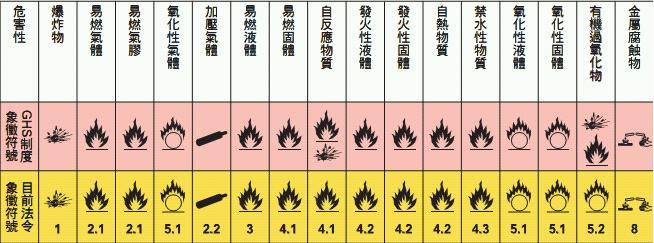 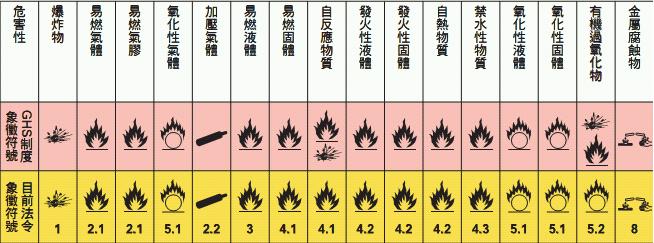
Figure 1 Comparison of GHS Hazard Pictograms with Current Regulations
Figure 2 GHS Labelling of Hazardous Substance Containers
The Safety Data Sheet (SDS) has 16 sections and differs little from the current MSDS format. The differences are that sections 2 and 3 are swapped and the sub-items of other sections are expanded. For example, in the ecological information of Section 12, the current format has a single sub-item (possible environmental impact/environmental distribution), whereas the GHS has five (ecotoxicity, persistence and degradability, bioaccumulation, mobility in soil, and other adverse effects).
The list of regulated substances has been expanded. Dangerous goods currently fall into six categories (explosive, flammable, oxidising, ignitable liquid, combustible gas and explosive substances), while the GHS adds three more: oxidising gases, gases under pressure, and metal corrosives. Harmful substances currently comprise 371 chemicals — organic solvents under the Organic Solvent Poisoning Prevention Rules, specified chemicals under the Specified Chemical Substances Hazard Prevention Standards, and harmful substances in the Permissible Exposure Limits for Airborne Hazardous Substances in the Workplace — whereas the GHS has 27 hazard classes; in principle it applies to any chemical meeting the classification criteria, giving broader coverage.
Because the true spirit of the GHS is to provide a globally consistent standard for classifying chemical hazards, the UN hoped member states would fully implement the GHS by 2008, and APEC hoped members would implement it on a voluntary basis by 2006 — though this year's APEC Chemical Dialogue has recommended deferring to 2008. Should Taiwan need to implement the GHS fully in line with international trends, manufacturers' current labelling and MSDSs would need almost complete updating, with wide-reaching impact. Businesses should therefore watch how this system develops and plan ahead to reduce the impact.
|